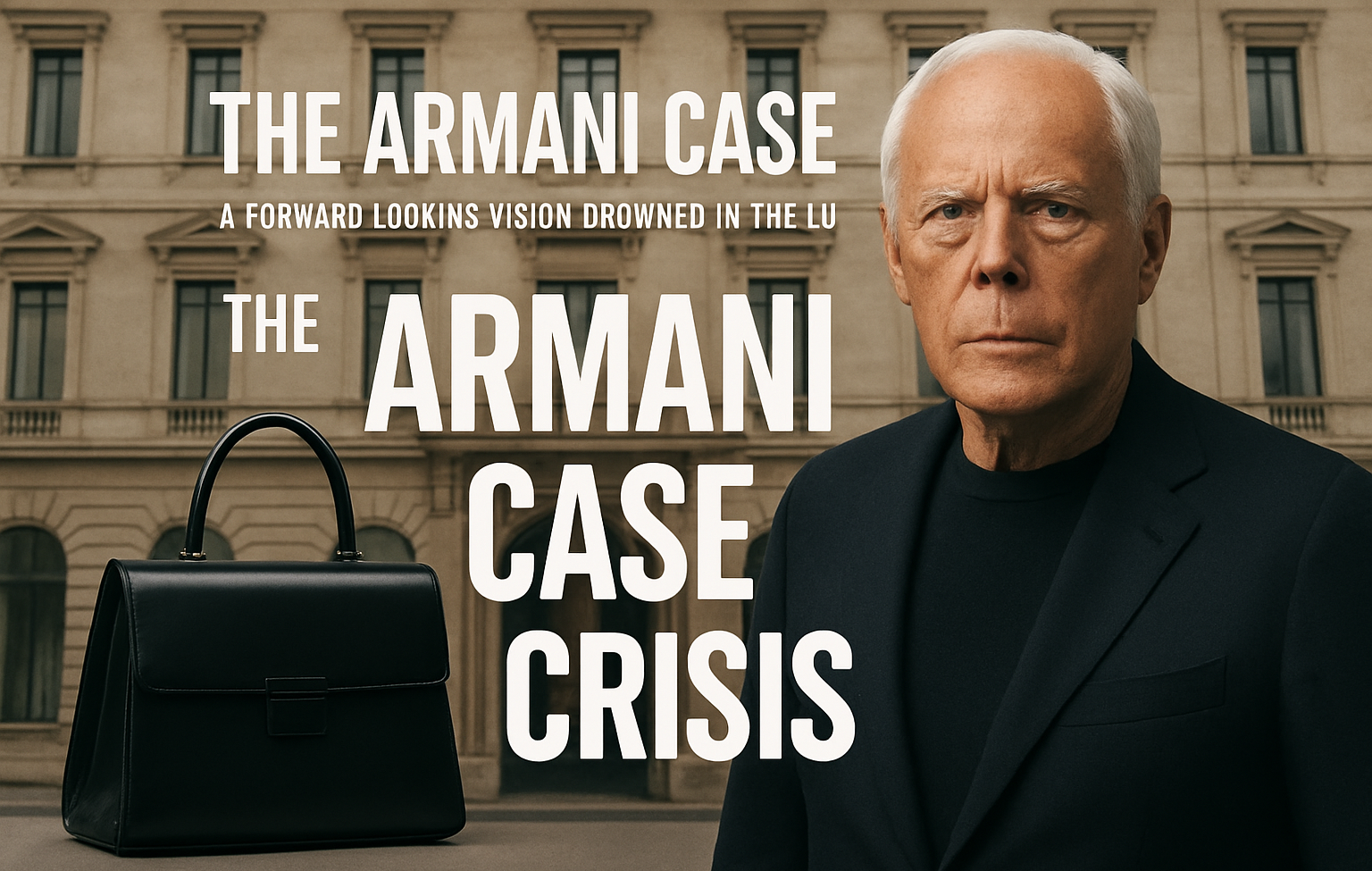
The Armani Case: A Forward-Looking Vision Drowned in the LuxurTheArmani Casey Crisis

As often happens following the death of a great founder, a delicate period begins in
which the choice of a successor and the continuity of the entrepreneurial vision come
into play. With foresight, “King Giorgio” planned the future of his empire well in
advance. “I want the fruit of so much hard work, this company to which I have given
my entire life and all my energy, to continue, for a long time, even without me.” The
total estate left by Giorgio Armani is estimated to be worth between 9.5 and 13
billion. Armani S.p.A., which is not publicly listed, has 8,700 employees and
generates over €2 billion in annual revenue. In 2016, and again in 2023, the
company approved a new corporate statute designed to ensure group stability and
management continuity, avoiding both the entry of external parties and any stock
market listing for at least five years. The Giorgio Armani Foundation, created as the
custodian of the brand’s identity, was established to safeguard these objectives and
ensure that the company remains under family control. The corporate system
includes six classes of shares with different voting rights. Classes A and F, which
hold 40% of the capital, control over 53% of the voting power, thereby guaranteeing
stability and strategic direction. The statute also establishes several fundamental
principles: balanced financial management, profit reinvestment, and the preservation
of an “essential, modern, elegant and understated” style. In the new organizational
structure, the Board of Directors appointed Giuseppe Marsocci as Chief Executive
Officer. Leo Dell’Orco was chosen as Chairman of both the Board and the
Foundation, while Silvana Armani, the designer’s niece, was appointed Vice Chair.
But what is the role of the Armani Foundation, and why should a fashion house have
one? It is a separate legal entity from the fashion house itself, created to safeguard
the brand’s legacy, values, and long-term independence. While Armani S.p.A.
operates as a private company involved in the daily business of designing,
producing, and selling luxury goods, the Foundation acts as a controlling body,
holding shares and voting rights to ensure continuity and strategic direction. This
structure helps maintain stable governance, prevents stock market pressure, and
often brings tax advantages. It also allows the brand to engage in cultural or
philanthropic initiatives without compromising its core business. In Armani’s case,
the Foundation guarantees that the company stays true to the founder’s vision, with
a long-term approach that prioritizes brand identity over short-term profits.
The Armani fashion house operates in the luxury goods sector, currently undergoing
rapid transformation and facing unprecedented pressure. According to Confindustria
Moda, the first half of 2025 saw a 4.1% drop in exports for the Italian textile and
fashion sector compared to the previous year. This slowdown is linked to a number
of factors, including shifting consumer preferences, the erosion of the traditional
price-value relationship, and the rise of the second-hand market, which is altering
how luxury goods are perceived and affecting the customer triangle. The costumer,
as the final decision-maker and arbitrator, now educates companies. Moreover, it is
the first time that the two main drivers of demand in the sector, the United States and
China, have simultaneously slowed down. While the major groups remain resilient, a
more cautious approach and defensive strategies are emerging, revealing a sector in
transformation that is attempting to protect its historical value.
It is certainly unhelpful that in recent years, various brands have been caught up in
scandals related to their production chains, particularly in the context of the
make-or-buy approach. Giorgio Armani too became the focus of media attention: in
April 2024, it was revealed that a handbag sold for approximately €1,800 was being
produced in workshops in the province of Milan, where Chinese laborers were being
exploited by unscrupulous entrepreneurs. The production of bags and accessories
for 2024 had been outsourced to third-party companies, which lacked the actual
manufacturing capacity required. These suppliers made use of factories employing
undocumented workers in poor hygienic and living conditions, often housed in
factory-dormitories. The workers were paid per item (between 50 cents and €1 per
piece), while the products were then resold to the brand at bargain prices (€15 for a
belt). The scandal led to court-appointed oversight of Giorgio Armani Operations
S.p.A. Such scandals attract media attention, legal investigation, and negative public
reaction, which can affect sales, investor confidence, and long-term reputation. For a
brand like Armani, which positions itself as a symbol of elegance and responsible
luxury, maintaining ethical standards throughout the supply chain is not just a moral
obligation, but a strategic necessity.
Despite the general difficulties, certain brands such as Hermès, Rolex, Cartier, and
Loro Piana continue to thrive due to a strong focus on high-quality materials and
products that maintain or even increase in value over time. These brands stand out
for their ability to tell a coherent and unique story, becoming symbols of desirability.
Uniqueness and consistency, beginning with the unstructured jacket of 1975, are key
strengths of the fashion house. Armani occupies a distinctive position within this
context, thanks to a strategy based on independence and brand coherence. Giorgio
Armani has always rejected acquisition offers from luxury giants such as LVMH and
Kering, choosing instead to preserve the creative and managerial autonomy of his
group. He has also implemented structural and sustainability changes, being one of
the signatories of the Fashion Pact, a global alliance among leading fashion and
luxury brands aiming to achieve net-zero carbon emissions by 2050.
Armani holds a strong and well-defined market position, with a synergistic
multi-brand strategy that allows it to cover different market segments. The main line
represents pure luxury, Emporio Armani acts as a bridge, and Armani Exchange
targets mass-market consumers. Expansion has also reached the ultra-luxury
segment, with projects such as Armani Home and the Armani Hotels in Milan and
Dubai. From an operational perspective, the group adopts a make strategy in design
and creativity, while outsourcing (buy) the production of standardized components, in
line with common industry practices. Wearing Armani’s main line remains a symbol
of belonging to elite circles, particularly among European and Asian elites, reflecting
a strong product perception and an emotional attachment to the brand.
The passing of Giorgio Armani was undoubtedly a major global event, drawing
attention not only from the fashion industry but also from the general public. It offered
many people the chance to appreciate firsthand the scale and significance of a
company that holds extraordinary economic and social value. The company is
placed in the luxury sector, which is facing significant challenges, including shifting
consumer preferences and increased scrutiny on ethical practices, as highlighted by
recent controversies involving Armani’s supply chain. Despite these pressures,
Armani’s products continue to hold strong value and prestige in the market, thanks to
their consistent quality and emotional appeal to loyal customers. Moving forward,
maintaining a balance between financial discipline, brand integrity, and adaptability
will be essential for Armani to preserve its leadership and economic strength in a
changing luxury landscape.