Alternative Scenarios to the U.S. Hegemonic System

Authors: Rozem Dila, Catalina Pérez Chica, Esteban Reyes Guzmán, Sarah Zebalos Cipolli
Keywords: Hegemony, United States, Democracy, Realism, Geoeconomic fragmentation.
The United States has dominated the international system for decades, but as emerging
powers reshape global politics, is the world shifting toward a new order? Promptly after the Cold
War, the U.S. established itself as the chief supporter of global security, with NATO serving as
the main forum. However, recent remarks by President Donald Trump have cast doubt on the
sustainability of this role. In February 2024, Trump suggested that the U.S. might not defend
NATO allies, even saying that Russia could “do whatever the hell they want1” to those nations.
This occurrence signals a potential shift in U.S. foreign policy, one that correlates United States’
approach before World War II, when the U.S. pursued an isolationist stance, avoiding engaging
in European conflicts until necessity dictated otherwise, and today, as economic pressures,
domestic political shifts, and geopolitical rivalries challenge U.S. dominance, a new
transformation is possible. If the United States is pulling back from its traditional leadership role,
what alternative structures could emerge in the international system? This paper explores the
future of global governance in a world where U.S. hegemony is no longer given, analyzing
regional power dynamics, security alliances, and shifting geopolitical frameworks through an
academic perspective.
Post-Cold War World Order
With the end of the Cold War in 1991, the dissolution of the bipolar international system
and the emergence of a unipolar world made the United States the uncontested leader. Once no
longer constrained by the Soviet Union, the U.S. expanded its influence through a network of
military alliances, economic liberalization efforts, and the promotion of liberal democratic
values. The U.S characterized this “unipolar moment” with military interventions, such as in the
Gulf War, Kosovo, Afghanistan, and Iraq, and also the enlargement of NATO to include Warsaw
Pact countries, and the institutional dominance of organizations like the International Monetary
Fund (IMF), World Bank, and World Trade Organization (WTO). These institutions, often
shaped by Washington Consensus policies, facilitated the global spread of free-market
capitalism, reinforcing U.S. economic and ideological supremacy. Moreover, the United States
maintained a strategic global military footprint, with forward-deployed forces and security
guarantees across Europe, Asia, and the Middle East. Politically, it positioned itself as the
defender of a liberal international order, underwriting global stability under its leadership.
In whatever way, like all great powers throughout history, the U.S. always faced supremacy
challenges. Comparatively, as the Cold War saw the world structured around two competing
blocs–the U.S.-led West and the Soviet sphere–the 21st century is witnessing the rise of
alternative power centers, particularly in Eurasia. China’s economic and military expansion,
Russia’s geopolitical assertiveness, and the increasing influence of regional alliances suggest that
the unipolar moment may be facing its downfall.
Declining Integration During the U.S Hegemony
Over the last decades, economic and political landscapes have undergone rough shifts,
proved by inclinations towards protectionism alongside evolving geopolitical dynamics. Rising
state intervention and radical swift of trade relations reflect broader and strategic realignments,
with the polyvalent role of the United States in matters of global shifts in diplomatic relations.
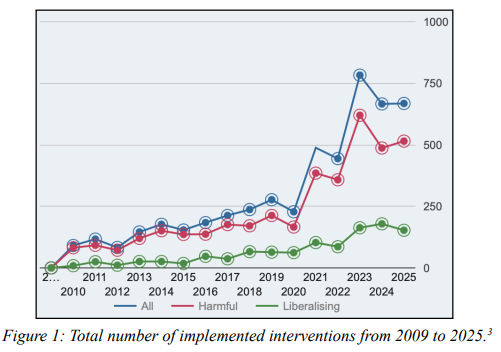
Nevertheless, this pattern is not solely driven by the major protagonists. Indeed, as shown by
Figure 1, starting from the 2008 Great Recession, governments worldwide have implemented
3775 interventions against foreign commercial interests, contrasted just by 1075 liberalizing
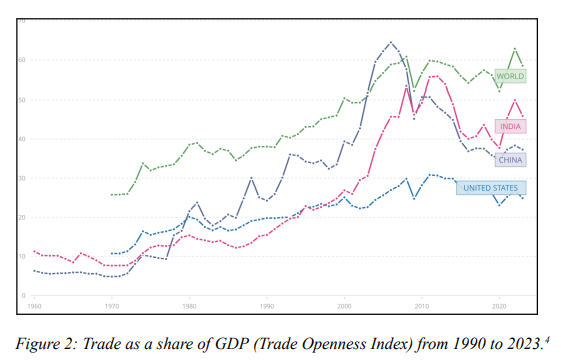
policies2. This phase has also witnessed a relative decline in trade-to-GDP trends compared to
earlier periods. As of 2023, there exists a particular emphasis on the downturn of India and China
(Figure 2).
3 Taken from The Global Trade Alert, Global Dynamics (2025)
4 Taken from multiple sources, compiled by the World Bank (2025)
The distinction from the rising tendency before 2008 has coincided with broader strategic
considerations, reflecting how economic measures intersect with supply chain vulnerabilities and
national security concerns, thus shifting diplomatic priorities. Indeed, U.S. policy ramifications
extend beyond trade and have been a key factor in shaping this evolving landscape. The outcome of the Trump Administration’s front-runner choice concerning the imposition of tariffs (against
Canada, Mexico, and China) and the erosion of previously negotiated exemptions with its allies
has turned out to be even more controversial as sanctions on Russia have been extended without
U.S. participation. A proper explanation may be found in the disruption of long-standing energy
ties between Russia and Europe, forcing a realignment of global energy markets. Meanwhile,
strategic competition with China has intensified in the field of technology and security policy,
with tensions manifesting in heightened military presence in the Indo-Pacific, and efforts to build
stronger partnerships with allies in Asia and Europe.
The exemplification of political fragmentation inclinations regarding the changing dynamics of
the Russo-Ukrainian conflict and the strategic U.S.-China rivalry have contributed to an
escalation of geopolitical tensions and, thence, the erosion of traditional diplomatic linkages that
have been the implicit common rule governing international relations. As a consequence, these
disruptions from traditional trends reflect a shift from a globally integrated economy towards a
more fragmented geopolitical landscape, paving the way for emerging frameworks as an
unconventional arrangement that may respond to the nowadays political and economic panorama
in an increasingly multipolar world.
Current Political Panorama and Democratic Decline
As already mentioned in the previous sections, the United States’ role is changing on the
economic and political fronts, questioning the current efficiency and decoupling at a global scale
on this basis. As demonstrated in Fig. 3, there is a subtle yet indicative change in domestic
political organization in most of the regions of the world.
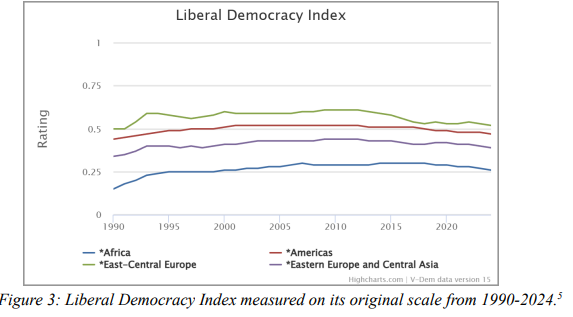
5 Taken from V-Dem (Coopedge et. al) 2024.
The previous graph measures democratic decline at a domestic level and aggregates it to a
regional measure, observing respective autocratic or democratic trends in the electoral process
and protection of personal freedoms against the government (Coopedge et. al). The change
corresponds to the political landscape post-Cold War, for instance, the fact that countries are
recently seeking to trade with politically aligned nations rather than prioritizing economic
efficiency (source article). The so-called geoeconomic fragmentation coupled with disruptions
such as the US-China tensions and the Russo-Ukrainian war accelerate this process, leading to
reshaped trade flows but most importantly highlighting a possible change in the international
system. Even though the indicators and general behavior are showing a possible change, the role
of the U.S. remains constant, as the major change is the slowing of global growth rates.
In purely geopolitical terms, the scene is less subtle than the current economic panorama. Two
major case studies stress the role of the U.S. as a possible declining power: The role of NATO in
the Russo-Ukranian War and the presence of China in the Global South along with the reinforced
Sino-Russian alliance. Historically, the North Atlantic Alliance was done as a defensive military
front to answer the Russian question, but today, it shows the weakness of the U.S. umbrella of
military power. A prime example is the recent EU initiative, ReArm Europe. Even if the
Russo-Ukrainian war is not a proxy conflict–per se, the current political order is made of the
U.S. protecting Europe and Europe allowing a degree of meddling so that the U.S. does not
become a marginalized power. The late and rather inefficient activity of NATO in this conflict
questions that ability, leading to initiatives that could–intentionally or unintentionally–undermine
the role of the U.S.
Logically if the European Union can no longer count on the U.S. for security, their response must
be swift, thus we have initiatives such as ReArm Europe that seek to harness outdated military
power. Coupled with the current Trump administration’s threats of pulling from NATO and other
key geostrategic points/conflicts, France stands as a possible leader to harness that military
power, being the only European nation in the Nuclear Club. On the other front, China harnesses
soft power in the Global South, especially with initiatives such as the BRI (Belt and Road
Initiative) that seeks to unite Eurasia through railways. The U.S.-China breakdown now
transcends economic disputes and war of knowledge and is evolving into a direct conflict as
third-class countries are seeking to challenge the traditional U.S. liberal order for the
economically beneficial China. In the scenario that our prediction becomes fulfilled, there are
possible alternatives that are to be explored in the following section.
Proposition of an Alternative Structure to the U.S Hegemonic Role
The contemporary international system is best understood through a realist approach,
fundamentally grounded in the principles of anarchy, state self-interest, and power balancing.
Following this framework, the future of international relations is shaped by the dominance of
realism, where power politics remain at the core of global interaction. Consequently, states will
focus on maximizing their power to secure their survival, as envisioned by classical theorists
such as Hobbes and Morgenthau. The increasing militarization, rising nationalism, and economic
protection of the current geopolitical climate reinforce the persistence of logic.
Because the future of international relations is likely to be shaped by the continued dominance of
realism, maximizing political power to secure influence with increasing militarization, rising
nationalism, and economic protectionism; regionalism emerges as a strategic response from
states that seek to consolidate power and enhance security by forming multilateral alliances that
strengthen their influence in an increasingly fragmented world. The multilateral framework
anchored by global institutions, such as the World Trade Organization, may well evolve in
response to the already-mentioned erosion of traditional linkages, paving the way for a new era
marked by more regionally tailored agreements. As stated in the previous sections, an indicator
of these relations would be the reinforcement today of the Cold War alliance system. Since the
landscape of International Relations is grappling with fresh challenges, considering geographical
proximity and common interests, coupled with the increasing nationalist trends, a regionalist
approach provides a framework for an alternative U.S. hegemonic system, highlighting economic
interdependence, local autonomy, and collective security.
Although it may seem contrary to the spotlight on realism, some elements of neo-functionalist
theories might be accommodated, as they postulate that successful regionalism is proportional to
the extent to which states respond to interdependence pressures by transferring national
sovereignty to regional governance mechanisms. In other words, while realism prioritizes state
sovereignty and national interests, it does not entirely impede functional cooperation for strategic
objectives. Hence, limited sectoral integration could still emerge as a pragmatic response to
shared challenges, as long as it reinforces state power rather than lessening it. Since regional
integration involves the transformation of expectations and dynamics, it is evident to consider the
Regional Security Complex Theory (RSCT), which is based on the assumption that the regional
level is the basis for security analyses due to the geographical proximity of interactions and
threats; besides appraising the coexistence of five sectors in which security relations are
considered: political, military, economic, social, and environmental.
Ultimately, the proposed alternative structure may be outlined in the conception of a new model
devised as the Regionalized Multipolarity Framework, using regionalism as an organizing
principle to replace U.S. hegemony through a multi-regional global order in which power is
balanced through regionally anchored governance systems; by merging four different pillars
focused on outlooks from a revamped RSCT and redefinition of the current functions of
institutions of global governance.
Since the RSCT fails to notice geographic areas where the states’ failure to function at the
regional level involves the absence of any form of security interdependence, the new framework
features adjacent great powers naturally penetrating nearby regions to address shared security
externalities. Thus, considering a proximity-based approach, regional powers are allowed to take
roles in organizing security and reducing the requirement for a hegemonic power like the U.S. to
intervene directly from afar. Hence, adjacent great powers act as hybrid actors, simultaneously as
regional and global participants in regional security dynamics.
This is, indeed, China’s involvement in Central Asia, depicting its interest in securing its borders
and keeping stability in its specific region. Correspondingly, this new groundwork minimizes the
tendency to overestimate the role of world powers as agents that decide on the level of security
globally.
In the same context, another factor encompassed by the proposed model lies in sovereign poles
based on regional coalitions, aimed at organizing each region around a bloc with a clear
governance structure, modeled after successful cases such as the European Union or the ASEAN
(poner significado). Therefore, for the remaining areas around the globe, there might exist a
union of the AfCFTA (African Continental Free Trade Area) and African Union; a remodeled
Shanghai Cooperation Organization (SCO) to balance Sino-Russian geopolitical interests; and
even a restructured MERCOSUR and UNASUR for the South American region.
The new framework must deliberate on the relationship regarding the devolution of sovereignty,
devising the relevance of cooperation benefits and costs to define ideal types of regionalism
depending on the geographical proximity and ideological complexity of the potential member
states. Specifically, in the case of considering status-driven motivations, the emergence of
symbolic regionalism is focused on building the legitimacy of state members towards external
audiences with possible institution-building for political correctness. On the other hand,
autonomy-oriented regionalism may be the front-runner option used to contest external
hegemons, as it is used towards endorsing mutual regime support. Lastly, by applying
transnationalism, regionalism may be based on addressing interstate policy issues, namely, many
of the current common market initiatives on a global scale.
Final Remarks
The evolution of the international system toward an alternative framework is becoming
an increasingly tangible reality, as multiple structural factors converge. The internal political
shifts within major powers, notably the United States, the reinforcement of defensive alliance
systems across the Indo-Pacific, and the intensification of geoeconomic fragmentation
collectively signal a departure from the post-Cold War unipolar order. Within a contemporary
realist framework—marked by the partial erosion of globalization—regionalism and
multipolarity emerge as the most plausible organizing principles of global politics. As previously
outlined, the redefinition of power distribution will likely be anchored in proximity-based
security complexes and sovereign regional poles, redefining the role of global governance
institutions. Thus, the central issue is no longer who dominates the current international order, but rather who will shape the architecture of the world to come.