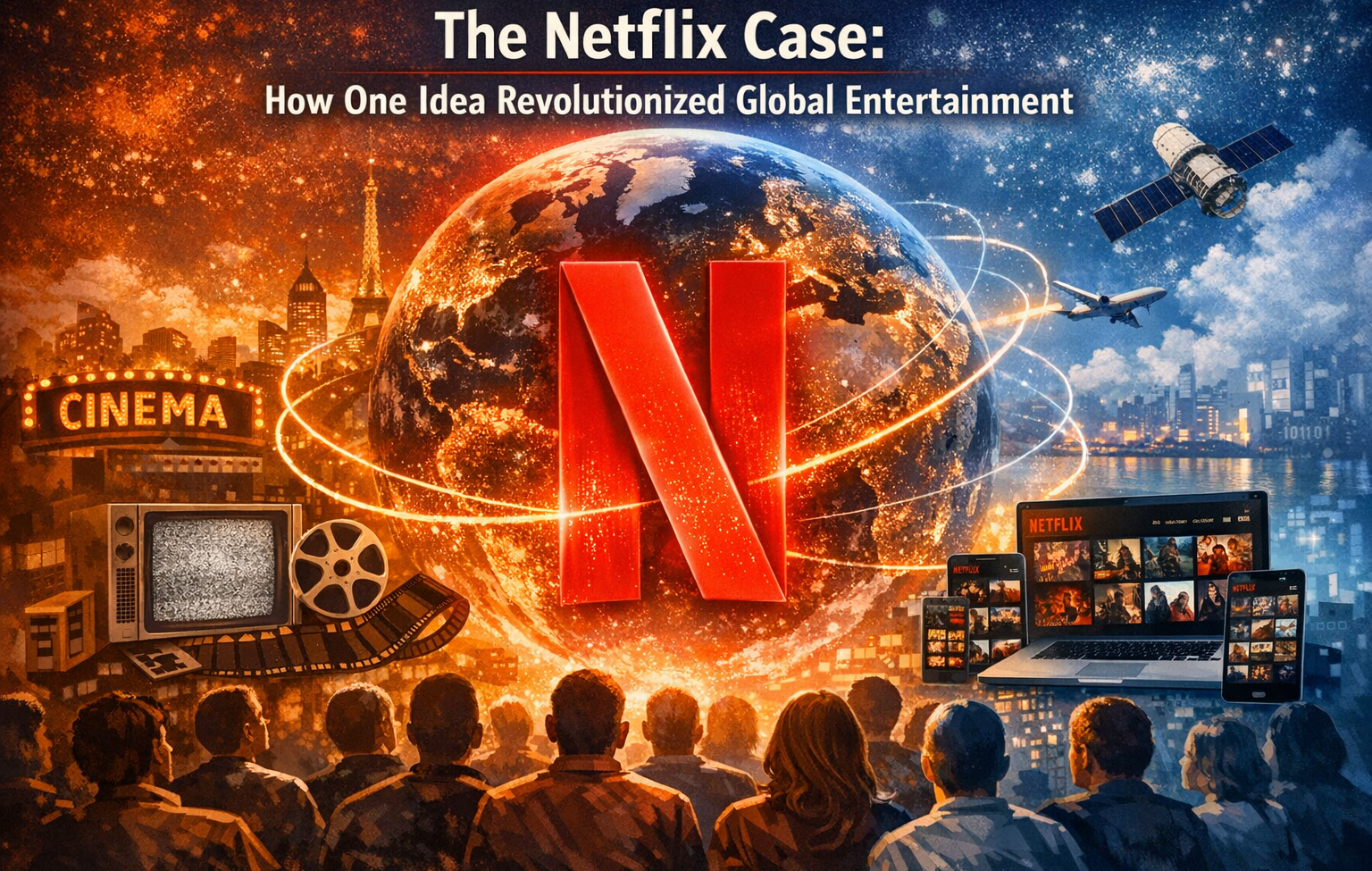
The Netflix Case: How One Idea Revolutionized Global Entertainment

At the end of the 1990s, the global entertainment industry was dominated by traditional models:
movie theaters, broadcast television, cable networks, and physical video rental stores.
Consumers adapted their habits to rigid schedules, late fees, and limited content availability. In
this context, Netflix emerged as a small startup with a seemingly simple idea: making movies
easier to access for everyone. What began as a DVD-by-mail service would eventually transform
how the world consumes entertainment. The Netflix case is not only a story of technological
innovation, but also one of strategic vision, adaptability, and a deep understanding of changing
consumer behavior.
Netflix was founded in 1997 by Reed Hastings and Marc Randolph in California. The original
concept was inspired by frustration with the traditional video rental model, particularly the
infamous late fees charged by companies like Blockbuster. Netflix proposed a radically different
approach: customers could order DVDs online and receive them by mail, returning them at their
convenience without penalties.
This idea alone challenged the existing industry logic. At the time, e-commerce was still
developing, and many doubted that customers would trust an online platform for entertainment.
However, Netflix identified an opportunity where technology, logistics, and customer-centric
thinking could intersect. The introduction of a monthly subscription model in 1999, allowing
unlimited rentals for a fixed price, further differentiated Netflix from its competitors and laid the
foundation for long-term customer loyalty.
The true revolution began when Netflix anticipated a fundamental technological shift: the rise of
broadband internet. While the DVD-by-mail business was still growing, the company invested
heavily in streaming technology, preparing for a future where physical media would become
obsolete.
In 2007, Netflix officially launched its streaming service, allowing subscribers to watch content
instantly on their computers. This move represented a turning point not only for the company but
for the entire entertainment industry. Streaming eliminated the constraints of physical distribution
and introduced a new level of convenience: content available anytime, anywhere.
Traditional media companies were slow to react. Many underestimated the potential of streaming
or feared it would cannibalize existing revenue streams. Netflix, on the other hand, embraced
disruption, even at the risk of undermining its own DVD business. This willingness to self-disrupt
became one of the company’s most defining strategic strengths.
One of Netflix’s most powerful innovations was not visible to users but operated behind the
scenes: data analytics. From the beginning, Netflix collected detailed information about user
behavior, including viewing habits, preferences, and completion rates. This data allowed the
company to refine its recommendation algorithm, offering personalized content suggestions that
increased user engagement and satisfaction.
Over time, data became central to decision-making at Netflix. Rather than relying solely on
intuition or traditional market research, the company used analytics to guide content acquisition
and production. This data-driven approach reduced risk and allowed Netflix to invest more
confidently in projects that aligned with audience interests.
Perhaps the most significant evolution in Netflix’s strategy was the decision to become a content
creator, not just a distributor. In 2013, Netflix released House of Cards, its first major original
series. The show was produced based on data insights indicating strong audience interest in
political dramas, director David Fincher, and actor Kevin Spacey.
The success of House of Cards validated Netflix’s original content strategy and marked the
beginning of a new era. By producing exclusive shows and films, Netflix gained greater control
over its content library and reduced dependence on external studios. This move also reshaped
industry dynamics, forcing traditional networks and studios to rethink their business models.
Netflix’s investment in original content expanded rapidly and globally, with productions in multiple
languages and countries. Series such as Narcos, Money Heist, and Squid Game
demonstrated that global audiences were eager for diverse stories, breaking the long-standing
dominance of Hollywood-centric content.
Netflix’s global expansion strategy was both ambitious and strategic. By 2016, the platform was
available in over 190 countries, making it one of the first truly global entertainment services. This
expansion required adaptation to different cultures, regulations, and viewing preferences.
The cultural impact of Netflix has been profound. The concept of “binge-watching” entered
everyday language, altering how stories are structured and consumed. Entire seasons released at
once encouraged deeper engagement and changed audience expectations. Moreover, Netflix
contributed to the democratization of content, giving voice to creators from regions historically
underrepresented in global media.
Despite its success, Netflix has faced significant challenges throughout its growth. Increasing
competition from platforms such as Amazon Prime Video, Disney+, HBO Max, and Apple TV+ has
intensified the so-called “streaming wars.” Each competitor has entered the market with strong
financial backing and valuable intellectual properties, forcing Netflix to constantly innovate and
invest heavily in new content.
One of the most critical issues has been the rising cost of content production. As Netflix
expanded its original programming, budgets for series and films grew dramatically. While
blockbuster productions attracted subscribers, they also increased financial risk. Maintaining a
balance between creative ambition and economic sustainability has become a central concern for
the company.
Netflix has also faced criticism related to subscription price increases, which have occasionally
led to subscriber losses in certain markets. Moreover, some critics argue that the platform’s vast
library can lead to content saturation, making it harder for high-quality productions to stand out.
Regulatory challenges have added another layer of complexity. Governments in various countries
have introduced rules concerning local content quotas, data protection, and taxation. Netflix has
responded by increasing investment in local productions and forming partnerships with regional
creators, turning regulatory pressure into an opportunity for cultural integration.
Nevertheless, Netflix has consistently demonstrated resilience by adapting its strategies. The
introduction of ad-supported subscription tiers, experimentation with password-sharing
limitations, and exploration of new formats such as interactive storytelling and mobile gaming
reflect the company’s willingness to evolve in response to market demands.
At the core of Netflix’s success lies a business model built on recurring revenue, scalability, and
technological efficiency. The subscription-based model ensures predictable income streams,
while the digital nature of streaming allows the company to serve millions of users simultaneously
with relatively low marginal costs.
Netflix’s emphasis on continuous innovation has also played a key role. The platform regularly
tests new features, user interfaces, and recommendation systems, often using A/B testing to
measure effectiveness. This experimental culture enables rapid learning and improvement,
reinforcing Netflix’s competitive advantage.
However, sustainability remains a long-term challenge. As competition increases and markets
mature, Netflix must find new ways to retain subscribers and diversify revenue. Investments in
gaming, live events, and partnerships with telecommunications companies suggest potential
future directions for growth.
The Netflix case demonstrates how one simple idea—making entertainment more accessible and
user-friendly—can revolutionize an entire industry when combined with strategic foresight and
technological innovation. Netflix did not merely follow trends; it anticipated them, often creating
new ones in the process.
From DVDs to streaming, from data analytics to original content, Netflix continuously redefined its
role in the global entertainment ecosystem. Its willingness to disrupt itself, embrace data-driven
decision-making, and invest in global storytelling reshaped not only business models but also
cultural consumption habits.
Today, Netflix stands as a symbol of digital transformation in the entertainment industry. Its
journey offers valuable lessons for companies across sectors: understand your customers deeply,
remain flexible in the face of change, and never be afraid to challenge established norms. In doing
so, Netflix has permanently altered how stories are produced, distributed, and experienced
around the world.