PROJECT: Critical Analysis of the IMF in the Current Political Scenario

AUTHORS: Ginevra Cavalli, Thomas Loiacono, Elena Meccariello
Keywords: Global economic governance, BRICS+, IMF, Bretton Woods, fragmentation.
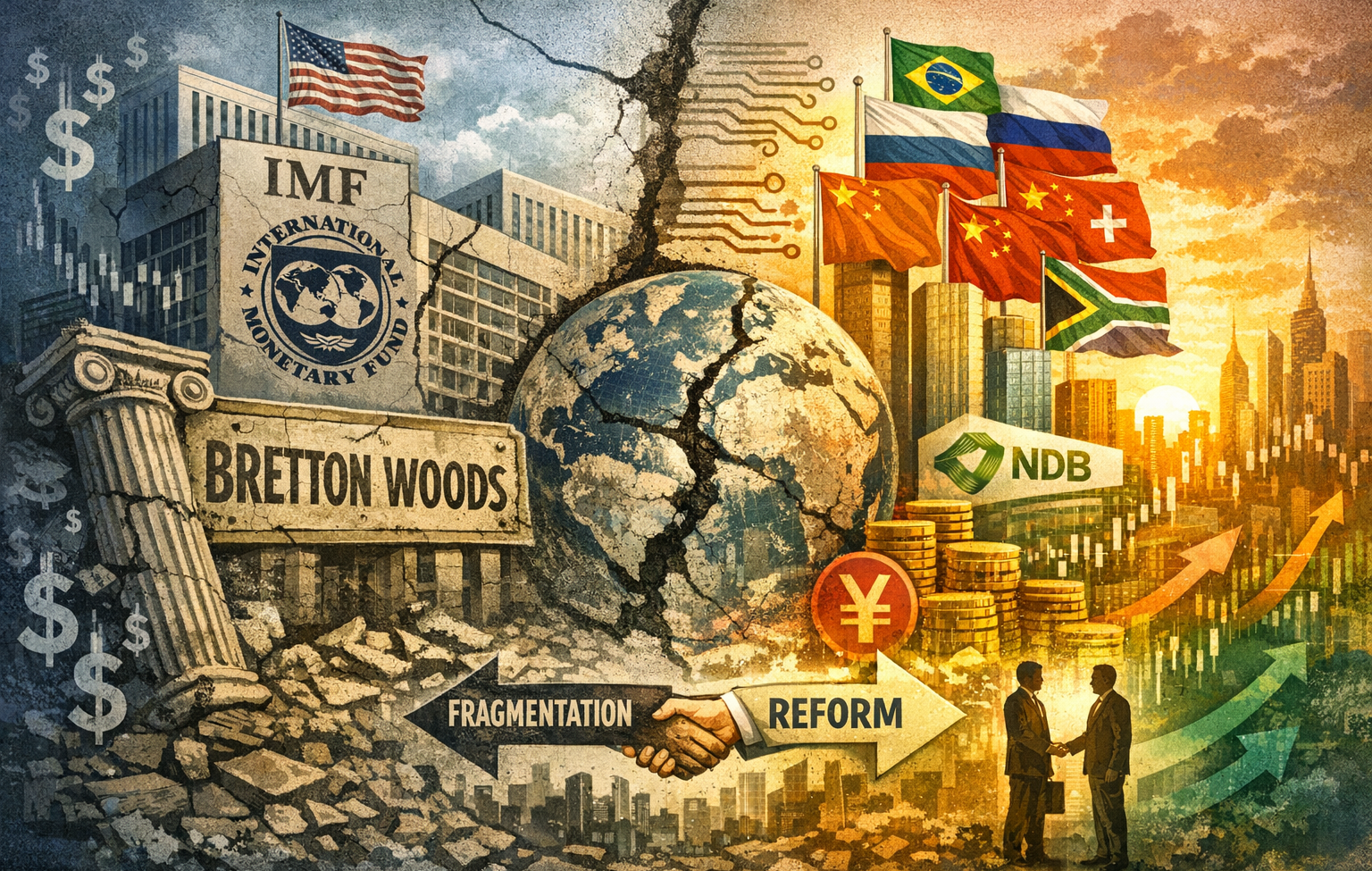
Since their establishment during the post-World War II era, the Bretton Woods
institutions–the International Monetary Fund (IMF) and the World Bank–have been central to
economic governance in the world through the support of financial stability and economic
growth. Nonetheless, as world economic power is redistributed and alternative systems become a
reality, the question arises: are the institutions of Bretton Woods still useful in the 21st Century,
or will they be outdated relics of the past? This essay aims to look at the shifting landscape of
international economic governance, with a particular focus on the IMF, as the main body dealing
with financial crises and acting as a lender of last resort for countries experiencing balance of
payment crises.
The IMF operates under a quota-based system, where its member contributes financially and
gains voting powers corresponding to its economic position. However, in return for finance
provision, the IMF imposes policy conditions that seek to ensure long-term stability in
economies but insist on structural adjustment that has sparked a ferocious criticism of the
Washington Consensus. In addition, critics argue that the decision-making power of the
institution is dominated by advanced economies, particularly the United States where the IMF
has its headquarters. While it has been charged with the responsibility to manage financial crises,
the IMF itself is presently facing a crisis. Emerging economies and blocs like BRICS (Brazil,
Russia, India, China, South Africa) seek a greater voice in global economic governance, while
the IMF has been behind in making reforms to address their needs.
Alternative institutions, such as the New Development Bank (NDB), aim to provide developing
countries with new sources of finance, challenging the traditional role and influence of the IMF
and the World Bank. Moreover, geopolitical tensions, financial fragmentation, and the rise of
alternative financial arrangements raise further questions about the ability of the IMF to remain
the leading institution in international financial stability. In this paper, we will consider these
challenges under two alternative views. Firstly, we will discuss increased criticisms against the
internal organization of the IMF, political biases, and lack of transformation and implementation
of reforms, as such elements undermine the utility of this esteemed organization, and, in the
same way, that of all other Bretton Woods institutions. On the other hand, we will look at
grounds on which the IMF remains crucial due to its crisis-management capability, global
footprint, and role in ensuring global financial stability.
Lastly, we will argue that the future of global economic governance will depend on whether the
Bretton Woods Institutions can successfully reform and adapt to a multipolar world and address
the needs of emerging economies and developing countries. From this examination, we will
conclude if the IMF and its counterparts will be able to evolve to meet the demands of the
modern world economy, or if we are witnessing the end of the Bretton Woods era as we have
known it.
Quota Assymmetries
For this 80-year-old institution, one of the biggest challenges is its rigid structure, which
has made sorely needed reforms difficult to achieve in a rapidly evolving global economy. At the
heart of the issue are quotas and the IMF’s failure to redefine these allocations that determine not
only a country’s voting power but its access to IMF resources. This is evident when we consider
the fact that the 14th Quota Review was released only in 2016, despite being agreed upon in
2010 following the North Atlantic Financial Crisis (NAFC), and that the 15th review was due in
2015 and was concluded in 2019, with no changes. Such delays are indicative of the institution’s
failure to respond timely to asymmetries defining its architecture. Emerging economies such as
China and India that have come to play an ever-more important role in the world’s economy are
still underrepresented in comparison to developed countries. On a purchasing power parity basis,
emerging markets and developing economies (EDEs) account for nearly 60% of global output as
of 2024, whilst advanced economies’ (AEs) share has shrunk to some 40%. Yet the IMF’s
governance structure continues to mirror the post-World War II economic power hierarchy,
heavily skewed in favour of advanced economies, especially the G7. The unwillingness of these
established economies to support broader governance reforms, exemplified by the United States’
five-year delay of the 14th Quota Review ratification, further illustrates the rigidity of the
system. The absence of timely reform is further deepened by geopolitical tensions which threaten
the stability of the system by making international cooperation more challenging.
Geopolitical Tension
A source of geopolitical tension in the past decade has been China’s increasing economic
influence, as its economy nears the size of the United States’, has created relevant challenges to
global economic cooperation. Up until 2015, China’s integration into the global economic system
was encouraged, as reflected in its accession to the World Trade Organization (WTO) in 2001.
But China’s rapid advances in economics and technology, combined with the growth of its
military, have made it more a competitor than a partner in American eyes.
Furthermore, the geopolitical polarization of the world created by the recent tensions between the
US, China, and Russia, and between India and China, has significantly impeded the chances of
reaching consensus on how to reform quotas. Cooperation between the United States and China
will be essential to the IMF’s future, but current geopolitical realities concerning these two
nations render this prospect uncertain. The already strained cooperation between member
countries of the IMF, which undermines the institution’s ability to act efficiently, is further
compounded by competing bilateral lender countries which act as an alternative to the IMF’s
debt management role.
The Increasing Role of Bilateral Lenders and the Emergence of Alternatives
Financial fragmentation and trade obstacles render the IMF even less effective as a rise in
trade protectionism and curbs on capital flows also complicate the Fund’s ability to establish
coherent policies for its member states. Rising bilateral lenders such as China, many of whom
operate outside established schemes like the Paris Club, create a major risk of debt
fragmentation. In the past two decades, China has emerged as the world’s largest official lender.
However, the absence of China in the Paris Club has diminished the forum’s relevance and
hampered the bilateral creditor coordination on which the IMF relies in debt crises. For instance,
a multitude of developing countries fell into debt distress during the COVID-19 pandemic and
faced concurrent negotiations with China, private creditors, and traditional Paris Club lenders.
Negotiations were rendered more complicated for debtors with high levels of exposure to
Chinese debt via three primary mechanisms: Firstly, the fact that IMF staff requires information
and commitments for debt restructuring of Chinese lenders, a process made significantly more
difficult by the historical lack of cooperation between the PRC and the IMF. Secondly, the
skepticism of other bilateral and private creditors in regards to China’s participation in debt relief
which has hindered coordinated action. Lastly, the tendency of borrowers to sometimes use
Chinese finance to put pressure on IMF negotiators, leading to longer mediation periods.
Negotiations between the Republic of the Congo and the IMF in the latter half of the 2010s
exemplify this dynamic. After a decline in oil prices in the mid-2010s, the Republic of the
Congo, a small state with large oil reserves, sought help from the IMF in early 2017. IMF staff
concluded that the country’s overdue debts to China Eximbank were unsustainable and needed
immediate restructuring to improve the economic situation of the African nation. Despite efforts,
the negotiations stalled as China was slow to grasp the scale of the crisis, with an IMF official
noting that “China doesn’t wake up to how bad the problem is. Often, China is one to two years
late to when the crisis needs to be addressed” (Ferry & Zeitz, 2024). The lack of existing
mechanisms to facilitate collaboration between China and the IMF exacerbated delays, as neither
side had a common understanding of what “debt sustainability” was. The negotiations
culminated in 2019 with a reduction of Congo’s debt service by $370 million, but only after six
rounds of negotiations over two years when the IMF was finally able to approve an Extended
Credit Facility despite the urgent nature of the crisis. The correlation between oil exports and
Congolese GDP is particularly significant, as the country’s economy relies heavily on this
sector’s exports. As a result, this African nation is greatly exposed and vulnerable to a rise in oil
prices which typically trigger long-term instability both in economic and political terms. This
case study reinforces a larger issue: lack of coordination with rising powers such as China when
it comes to debt ultimately leads to the IMF’s inability to facilitate solutions. Thus, for the IMF
to remain relevant in the coming years, the cooperation between emerging creditors and the
existing institutions should encompass more than just simple increases in voting shares but
should also involve integrating preferences and paradigms for addressing debt crises.
Beyond its challenges in dealing with bilateral lenders like the PRC when it comes to debt
management, the IMF risks losing its significance in favour of alternative institutions even when
it comes to its crisis management task. Operational and bureaucratic inefficiencies as a result of
the complex decision-making processes pull the organization away from responding efficiently
to crises, effectively leading to a loss of its relevance in favour of Regional Financial
Arrangements (RFAs). During the North Atlantic Financial Crisis (NAFC), for instance, the IMF
played a subordinate role in bailouts of relatively small European economies like Ireland,
Portugal, Cyprus, and Greece as European mechanisms like the European Stability Mechanism
(ESM) had to supplement IMF resources significantly. Even though RFAs like the ESM continue
to depend on the IMF’s staff for the design of programs and access to occasional supplementary
liquidity, their increasing independence reduces the Fund’s prominence in the global economic
stabilization architecture. Beyond alternative mechanisms, the IMF’s struggle to maintain its
authority is aggravated by its perceived political biases which raise concerns regarding its
impartiality.
Loss of Credibility
The IMF’s credibility as a major economic institution of the international system is
increasingly undermined when it is perceived to be more political than effective. This is
especially evident when member nations perceive biases in its dealings with certain countries.
Critics maintain that the IMF serves the interests of wealthier nations, in particular the United
States. A common point of contention to support this theory seems to be the formula to establish
each member nation’s quota which determines its voting power as well as its borrowing capacity.
Additionally, the IMF’s decision-making process requires an 85% majority for major decisions,
which means that the US, holding the biggest voting share, has a sort of veto power. This was
made painfully clear to the rest of the international system when in 2019 the 15th IMF quota
review was unilaterally blocked by the US led by the Trump administration. Consequently,
critics argue that, because of such a setup, the IMF has primarily functioned in the national
interests of its wealthier countries, with little concern for emerging and developing economies.
The needs of advanced economies during the NAFC propelled the large doubling of quotas in the
14th review, after a 15-year hiatus, despite EDEs calls for larger increases in previous decades.
Even more recently in 2023, we observed the IMF’s inability to significantly change quota shares
with the 16th General Review of Quotas. Although it successfully increased quotas to SDR 715.7
billion thus guaranteeing the primacy of quotas in IMF resources, it further alienated emerging
powers as it failed to adapt their quota shares to their actual weight in the global economy. In this
case the IMF’s largest shareholders voted to increase quotas equi-proportionally. This meant that
each member’s quota was raised in proportion to their existing share without redistributing voting
power, something that had not been done in over 65 years.This allowed much of the Global
North to maintain their dominant position within the IMF.
If the IMF wants to regain its long-lost credibility and effectiveness, it needs to overhaul its
governance structure in order to become more representative of all its member countries, and not
simply a small share of them. This could be achieved through regular quotas reviews which
would allow emerging powers to receive their due influence in decision-making and so the
institution’s resources always match the current shares of the rapidly growing global economy.
Denying the reality that the economic centre of gravity has shifted from the North Atlantic to
Asia, and failing to adopt reforms that reflect this new reality would only mean further declines
in legitimacy and influence for the IMF. Without these reforms, the IMF is at serious risk of
losing its influence in favour of regional mechanisms and bilateral lenders which are increasingly
assuming more prominent roles and among them BRICS has taken a leading role.
Assessing the Aims and Capabilities of the BRICS+ and Other Emerging Systems
The BRICS bloc aims to rebalance global power by challenging the dominance of
Western-led groups like the G7 while supporting the needs of the Global South. However,
BRICS is not trying to overthrow the existing international system. Instead, it often works within
current institutions and acts as a strong negotiation force. This is clear in the Kazan Declaration,
where BRICS emphasized its commitment to established organizations like the United Nations,
World Trade Organization, International Monetary Fund, and World Bank to tackle global issues
like trade disputes, financial reforms, climate change, and human rights.
The Kazan Declaration highlights BRICS strategy of using existing systems to address global
challenges. For example, it suggests resolving trade issues through the WTO, pushing for
financial reforms via the IMF and World Bank, and handling health crises under the guidance of
the World Health Organization. BRICS also supports the G20 as the leading platform for global
economic cooperation, showing it values multilateral frameworks rather than opposing them
outright. Even on sensitive topics like democracy and human rights, BRICS reaffirms their
importance, though its members often interpret these values differently.
While some members, like Russia and China, take a more confrontational approach toward the
West, others, such as India, Brazil, and South Africa, prefer to reform global institutions to better
represent developing countries rather than completely replacing them. This diversity within
BRICS often makes it hard to align on a single agenda. For instance, China’s push for a BRICS
free trade agreement and greater use of the Renminbi has faced pushback from members worried
about China’s growing influence. This internal division within BRICS mirrors the internal
dynamics of the IMF, where different views and priorities between advanced economies and
developing countries often lead to discussion resulting in disagreements over policies,
governance reforms and the distribution of voting power.
Furthermore, there is reason to believe that neither the NDB nor the CRA was designed to
replace the IMF or World Bank, and both have their limits. The NDB, despite promoting local
currencies and offering simpler loan conditions, lacks the capital and reach of the World Bank
and has funded only a small number of projects. The CRA, meant to act as a financial safety net,
has strict rules and hasn’t been widely used. Instead of replacing the IMF and World Bank, these
initiatives give developing nations more options while still working within the global financial
system.
At the same time, BRICS’ growing diversity—especially with recent additions like Saudi Arabia,
Iran, and the UAE—makes it harder to stay united. Differences in political systems, economies,
and priorities often lead to disagreements. For example, rivalries between India and China or
Saudi Arabia and Iran can make it difficult to find common ground. Despite these challenges,
BRICS remains a powerful advocate for a multipolar world and a key voice for the Global South,
using its collective strength to push for fairer global governance.
Enduring the Role of the IMF in Global Economic Stability
After having explored the IMF’s weaknesses, it is important to recognize the factors that
ensure its continued importance in the global economic system. While the IMF faces increasing
competition from other financial institutions and criticism over its policies, its role in fostering
economic stability, providing financial assistance to countries in crisis, and offering expert policy
advice remains crucial. This section explores how the IMF has adapted to new global challenges,
its key functions that continue to address the needs of member states, and why it will remain a
cornerstone of international financial governance moving forward.
Reform Efforts
Although it may seem as though the IMF is unable to reform, recognising its limitations,
the IMF has embarked on reform efforts to adapt to modern economic realities and maintain its
relevance in a rapidly evolving global landscape. As previously mentioned, there are challenges
in adjusting the rigid institutional system of the IMF, however reform efforts (such as revising
the quota system and strengthening the surveillance mechanism) are present, they will be
discussed in more detail in this section.
One significant initiative involves ongoing discussions about adjusting quota allocations to better
represent emerging economies and developing nations. Quotas determine both the financial
contributions of member countries to the IMF and their voting power in decision-making
processes. Currently, advanced economies hold a disproportionate influence in comparison to
their global economic weight, leading to criticism that the IMF fails to reflect the changing
dynamics of the world economy. By realigning quotas to give greater representation to rapidly
growing economies such as those in Asia, Africa, and Latin America, the IMF aims to strengthen
its legitimacy, enhance trust among member states, and ensure a more balanced global
governance structure. These changes are crucial for fostering greater cooperation and
engagement from underrepresented nations.
In addition to this attempt in addressing representation, the IMF is also enhancing its surveillance
mechanisms to better identify and address contemporary economic challenges. With increasing
threats from novel issues such as climate change, digital currencies, and rising geopolitical
tensions, the IMF has expanded its analytical frameworks to incorporate these elements into its
macroeconomic assessments. For example, the IMF now integrates climate risk analysis into its
country-specific evaluations, helping nations assess the economic consequences of
environmental policies and adapt their strategies to mitigate risks. Furthermore, the IMF is
analysing the implications of the rise of central bank digital currencies (CBDCs) and private
cryptocurrencies, which have the potential to disrupt financial systems and challenge monetary
policy frameworks. By offering guidance on managing these innovations, the IMF ensures that
member countries can embrace technological advancements without compromising financial
stability. These initiatives reflect the IMF’s determination to remain a cornerstone of global
economic governance.
Crisis Management Role
The IMF was initially created to address the economic turmoil following the World Wars
and the Great Depression. Since its creation in 1944, it has evolved into a pivotal player in
managing global financial crises and offering assistance and policy advice to nations in need.
This is one of the most compelling reasons for the continuation of the fund: it plays a vital role in
managing global crises. The IMF has three primary functions, notably economic surveillance,
financial assistance, and capacity building. Through comprehensive surveillance of member
states’ economic and financial policies, the IMF aims to mitigate risks that could lead to financial
crises. This surveillance includes analysing a country’s macroeconomic policies, such as the ones
affecting exchange rates, governmental budgets, and financial sectors. However, it is important
to recognise that mitigating risks does not mean that the IMF can entirely prevent the outbreak of
financial crises, many exogenous factors at play could potentially lead to dire financial
conditions, an example is the bursting of a speculative financial bubble, another one is the
outbreak of unexpected global phenomena, such as COVID-19. This is where the IMF’s role as a
crisis manager comes in: the fund provides financial assistance to countries facing balance of
payments problems, this support offers member states temporary relief, enabling them to
implement necessary reforms to stabilise their economies. Moreover, the IMF provides technical
support to strengthen governance and fiscal management, particularly in low-income countries,
by providing a framework for sustainable economic development
Numerous historical examples highlight the crisis management role of the IMF. The 2008
financial crisis underscored the importance of a centralised institution capable of providing
emergency liquidity and preventing systemic collapse. With financial systems across the globe
destabilised, the IMF stepped in to provide emergency loans, liquidity support, and policy advice
to vulnerable countries. The financial stimulus provided by the fund was unprecedented,
moreover, they created a Flexible Credit Line to offer preemptive support to countries with
sound fundamentals during a period of heightened risks. In the years leading up to the 2008
global financial crisis, it seemed as though the IMF was losing its relevance, just as it appears to
be doing now, yet it was only a matter of time until the world realised that a centralised financial
institution is pivotal in dampening the effects of an unexpected crisis.
Similarly, during the COVID-19 pandemic, the IMF deployed emergency financing to over 90
countries, ensuring economic stability amidst unprecedented global disruptions. In 2020 the
organisation found itself responding to an unprecedented quantity of requests for emergency
financing. To deal with this over-demand and continue to aid countries’ crippling economies the
fund activated a temporary increase in access limits to its emergency financing instruments. The
fund’s instruments include the Rapid Financing Instrument (RFI) which is open to any IMF
member and comprises swift financial assistance to countries facing an urgent balance of
payments crisis and the Rapid Credit Facility (RCF) which is only accessible to lower-income
countries. During the pandemic, the Fund demonstrated its agility and activated extraordinary
measures allowing it to deliver emergency assistance without requiring a comprehensive
program to be in place, thereby expediting relief efforts and ensuring support reached every
member in distress. Furthermore, the IMF did not only provide emergency financing, but it also
extended grants for debt relief to 29 of its poorest member countries, called for bilateral creditors
to suspend debt payments from poorest countries, adjusted existing lending programs to
accommodate new and pressing needs, and provided real-time policy advice to overcome the
crisis.
This crisis management capacity, coupled with decades of experience, positions the IMF as an
indispensable player in global economic governance. In light of recent geopolitical challenges,
the IMF is pivotal in addressing the risks of geoeconomics fragmentations. By mitigating the
adverse effects of unilateral policies and advocating for open trade, the IMF helps ensure that
global economic cooperation continues to benefit its members.
Global Reach
The International Monetary Fund, along with the other Bretton Woods institutions (the
World Bank and the World Trade Organisation), possess a global reach and legitimacy that is
unparalleled by emerging systems such as BRICS. With 191 member countries, the IMF
facilitates international monetary cooperation and financial stability across diverse economies.
The World Bank and World Trade Organisation complement this global reach with their 189 and
166 members respectively by addressing critical global issues. Each institution has its precise
scope in the global financial system, the World Bank focuses on poverty reduction and
infrastructure, while the WTO promotes open trade and resolves disputes, ensuring
interconnected challenges are effectively managed.
In contrast, initiatives like BRICS–while influential–represent a smaller segment of the global
economy and lack the comprehensive infrastructure and universal legitimacy of the Bretton
Woods institutions. The BRICS group has sought to establish alternative financial mechanisms,
however, these efforts have not yet achieved the same scale or impact as the established Bretton
Woods institutions. A simple indicator is the number of member countries in the two systems, the
extensive global reach of the current traditional institutions is hard to replicate or even imitate.
The global reach is further exemplified by their ability to mobilise resources and coordinate
policies across a vast network of nations. This capacity is crucial for addressing complex,
transnational issues that require collective action and shared solutions. The IMF maintains a
unique and expansive global presence that enables it to effectively address worldwide economic
challenges. Bretton Woods institutions’ extensive membership, substantial resources, and
established legitimacy position them as indispensable actors in the international economic
system, with a reach and influence that emerging entities have yet to match.
While it is true that the modern world presents us with a political scenario where global cooperation and agreement seem increasingly challenging, this does not jeopardise the IMF’s role but simply heightens its
relevance. Paradoxically, a solution to bring member states closer together in their monetary
policies and to boost international cooperation and harmony would be to give the IMF more
operational insulation and independence, in order to avoid delays in decision making due to
growing discrepancies between the big player’s priorities (namely the US, Europe, and China)
This would allow the IMF to pursue its goals without the constant challenge of disagreements
between leading economies, while still strengthening the global financial system and fostering a
more stable and cooperative international economic order for all.
Moreover, the IMF’s favorable interest rates and structured repayment terms make it a
promising option for nations in financial distress. Its existence provides a safety net, preventing
panic and loss of confidence in the global financial system. If the IMF ceased to operate, trust in
international financial cooperation could erode, leaving countries without a reliable mechanism
to address crises and ensure stability.
A hypothetical collapse of the IMF would be detrimental, posing a severe threat to the global
financial system, leading to financial fragmentation and undermining international cooperation.
Without the IMF, countries might resort to isolated or incompatible frameworks, exacerbating
economic inequalities and creating a fragmented, less stable global environment. By pursuing
reforms, such as more inclusive quota allocations and streamlined lending practices, the IMF can
strengthen its role as a unifying force, mitigating financial fragmentation and promoting greater
economic cohesion worldwide.
Case Study: A Comparison with China’s Belt and Road Initiative (BRI)
Critics often compare the IMF’s practices to China’s Belt and Road Initiative (BRI),
highlighting differences in approach. While the BRI has gained favour in developing nations for
its focus on infrastructure and minimal policy conditions, it has been accused of engaging in
debt-trap diplomacy, prioritising Chinese strategic interests over the long-term economic health
of recipient nations. In contrast, the IMF, despite its stringent conditions, focuses on restoring
financial stability and fostering sustainable growth. While IMF loans often come with policy
reform requirements known as conditionality, they aim to address systemic economic issues
rather than securing geopolitical leverage. This distinction emphasises the importance of the IMF
in maintaining a fairer global financial system.
The Rise of Alternative Economic Systems and the Future of Global Governance
Within the Global South, there is an increasing feeling that the institutions created during
the Bretton Woods conference are meant to only serve the interests of the West, keeping
developing countries disadvantaged and not represented enough in the decision-making bodies of
these institutions. The current emergence of alternative systems is a testament to the fact that
developing countries want to see a change in the global economic dynamics if reforms are not
implemented.
Emerging Systems Challenging the Global Economic Order
The global economy is changing as new systems emerge to challenge the dominance of
traditional institutions like the IMF, World Bank, and G7. One example is the rise of Central
Bank Digital Currencies (CBDCs). China’s Digital Yuan, part of its DCEP initiative, is designed
to potentially make the Renminbi a global currency and reduce reliance on the U.S. dollar. At the
same time, countries like India and the EU are working on their digital currencies to create
alternatives to the SWIFT payment system, which is largely controlled by Western powers.
Regional financial institutions are also stepping up. The Asian Infrastructure Investment Bank
(AIIB), led by China, funds infrastructure projects across Asia, offering a fresh alternative to the
World Bank. Similarly, the Eurasian Economic Union (EAEU) is building new trade and
financial systems to increase cooperation among post-Soviet countries without depending on
global institutions.
In trade, regional agreements and currencies are gaining importance. Initiatives like the African
Continental Free Trade Area (AfCFTA) and the Regional Comprehensive Economic Partnership
(RCEP) are strengthening trade within regions, making countries less dependent on global
organizations like the WTO. New regional currencies, such as the proposed Eco in West Africa,
aim to reduce reliance on major foreign currencies like the U.S. dollar and the Euro.
However, a major focus of attention has been on BRICS and its expansion, with new members
and the creation of its own institutions. The BRICS is a coalition of major emerging economies
that positions itself as a counterweight to the G7, advocating for a more balanced and inclusive
global economic order focused on promoting economic, political, and development cooperation
through mostly annual summits. In 2015, the bloc established two new multilateral institutions,
the New Development Bank (NDB) and the Contingent Reserve Arrangement (CRA), to
compete with the World Bank and the International Monetary Fund, respectively.
The NDB is a multilateral development bank that supports infrastructure and sustainable
development projects in emerging markets and developing economies. Headquartered in
Shanghai, China, the NDB emphasizes funding initiatives that align with the Sustainable
Development Goals (SDGs), focusing on climate-smart, disaster-resilient, technology-driven,
and socially inclusive projects. With an initial authorized capital of $100 billion, equally
subscribed by its founding members, the bank has also expanded its membership to include
countries like Bangladesh, Egypt, the United Arab Emirates, Uruguay, and Algeria.
What sets the NDB apart from Western institutions like the World Bank is its focus on fostering
financial independence for developing nations. The bank actively promotes the use of local
currencies in its lending practices to reduce reliance on the U.S. dollar and mitigate exchange
rate risks, empowering member nations to have greater control over their financial systems.
Additionally, the NDB prioritizes inclusivity in its operations, focusing on sustainable
development tailored to the unique needs of emerging economies. With regional offices in
countries like South Africa, Brazil, India, and Russia, the NDB enhances its outreach and
operational efficiency, challenging the traditional dominance of Western-led financial institutions
in the global development landscape.
The CRA is a financial framework that provides mutual financial support during short-term
balance of payments crises. It aims to protect member countries from global liquidity pressures,
such as currency instability caused by financial shocks. The CRA operates through central bank
liquidity swaps, allowing member countries to access U.S. dollars in times of financial stress
while repaying the borrowed amount with interest. With a total resource pool of $100 billion,
member contributions vary, reflecting their economic standing, with China contributing the
largest share.
Unlike the International Monetary Fund, the CRA emphasizes mutual assistance without the
stringent policy conditions typically associated with IMF programs. It represents a move toward
greater South-South cooperation, offering a financial safety net for BRICS nations and reducing
dependence on Western-led institutions. While some see it as a competitor to the IMF, the CRA
complements the global financial safety net by providing a regional alternative that aligns more
closely with the priorities and needs of its member states. Its structure and operations reflect a
more equitable and localized approach to financial stability compared to the broader, often
conditional, framework of the IMF.
BRICS+ Dedollarization Effort
Some BRICS members have made de-dollarization one of their main goals, working to
reduce reliance on the U.S. dollar in global trade and support economic independence. A key part
of this is creating a payment system that uses the currencies of its member countries. The New
Development Bank (NDB) has already started giving out loans in local currencies, like the
Chinese yuan, which now makes up about a fifth of its total lending. BRICS has also developed
tools like BRICSpay, a payment app that lets countries trade in non-dollar currencies. This helps
members avoid the risks of relying too much on the dollar, such as being affected by sanctions or
sudden changes in exchange rates. Another idea BRICS is exploring is creating a basket of
currencies, combining member nations’ currencies to provide a stable alternative for global trade
and reduce dependence on any single currency. Digital currencies are also part of the plan,
offering new ways to bypass the dollar in global finance. Additionally, the group has set up the
Payment Task Force and the Contingent Reserve Arrangement to give members more financial
security during crises without needing help from Western institutions.
BRICS is also focusing on key markets to gain more influence and further its de-dollarization
goals. One big target is the energy market. With new members like Saudi Arabia, Iran, and the
UAE, BRICS now includes some of the world’s top oil and gas producers. This gives the group a
chance to challenge OPEC by controlling a large share of global energy supplies and
encouraging energy trade in non-dollar currencies. Another focus is the agricultural sector.
Russia has proposed an independent grain trading system for BRICS, which makes sense since
the group produces 42% of the world’s grain each year. This could strengthen BRICS position in
setting grain prices and help counter-sanctions from the U.S. and its G7 partners. These efforts
show the commitment of BRICS to building a more balanced and flexible global economy that is
less dependent on the dollar.
Despite these ambitions, fully achieving de-dollarization remains unlikely in the near future. The
U.S. dollar’s deep integration into global trade, finance, and reserves makes replacing it a
monumental challenge. The lack of a single, trusted and widely used alternative limits progress;
thus, if the only way to dethrone the dollar is to crown China the financial foreman of the world,
that’s not creating a multipolar system. That’s just trading one master for another. Do we think
that India is going to want a world where the renminbi is the dominant currency in Asia?
De-dollarization efforts can present a direct challenge to the IMF, as the U.S. dollar is a key
component of the IMF’s Special Drawing Rights (SDR) basket – the IMF foreign exchange
reserve assets – standing at 43%, followed by the Euro at 29%, the Chinese Renminbi at 12%,
and both the Japanese Yen and the Pound Sterling at 7%.
By promoting alternative currencies, BRICS could weaken the IMF’s leverage over global
economic stability. While the IMF’s power is not solely tied to the dollar, widespread adoption of
alternative financial systems could challenge its traditional functions. Mechanisms like the
Contingent Reserve Arrangement (CRA) are a competitive alternative to the IMF, potentially
reducing global demand for IMF resources and challenging its crisis management role.
However, the IMF could prove its flexibility to respond to this challenge by diversifying and
enlarging its SDR basket. Therefore, while de-dollarization could diminish the IMF’s
geopolitical influence, it also provides an opportunity for the IMF to evolve within a more
multipolar financial landscape led by emerging economies.
The Future of Global Economic Governance Depends on the Bretton Woods Institutions
Response to These Emerging Systems
The global economy is becoming multipolar, and globalization is changing. The future of
the global economy will plausibly remain globalised in general – with globalisation itself
changing shape – while simultaneously becoming more national in certain respects. Initiatives
like the NDB, the CRA and regional trade agreements help developing countries rely less on
Western-led systems. Digital currencies are creating alternatives to traditional banks and
reducing dependence on the U.S. dollar. Countries are also trading more in their own currencies
and using sovereign wealth funds to boost independence. These shifts challenge the current
international economic system, forcing the IMF and the World Bank to reconsider their roles in
global economic governance.
The future of Western-led Bretton Woods institutions will hinge on how they respond to the
concerns of the Global South. Viewing BRICS and other emerging systems as threats to the
established order, therefore adopting a confrontational stance, might have a short-term deterrent
effect on developing countries like India who do not want to antagonize major economic players
like the United States, but it risks deepening the Global South mistrust of the dollar-dominated
financial system and amplifying concerns over the weaponization of economic tools. Moreover,
a confrontational approach could lead the West to dismiss calls for reform within the IMF and
the World Bank, perpetuating the very grievances driving the momentum of BRICS. In the long
term, such a strategy risks accelerating efforts by China and Russia to establish alternative
systems of global economic governance, potentially alienating democratic countries like India
and Brazil, which have traditionally aligned with the West on many issues. This is the reason
why a cooperative approach would mitigate these risks and foster a more inclusive global order.
Therefore, a West that recognizes the concerns of the Global South will seek to reform the IMF
by increasing representation for developing countries by realigning voting quotas and
implementing a rotating leadership model that allows equitable access regardless of economic
status. The IMF should also reconsider the stringency of its conditional lending and expand
alternative lending tools, such as those used during the Covid-19 pandemic crisis. Repeated
delays and political roadblocks, such as the prolonged negotiations of the 14th and 15th quota
reviews, have damaged the credibility of the IMF. Implementing the above-detailed change
would address long-standing grievances and reduce the appeal of BRICS as an alternative,
positioning it instead as a complementary force in global governance. Likewise, the World Bank
must also implement similar reforms to its governance, streamline its loan approval process,
expande finances in specific thematic priorities, and consider options to lend in local currencies,
to make financing more accessible for developing countries.
There is evidence that some countries use BRICS membership as leverage to push for reforms
within the IMF, underlining the urgency of these changes. The UN Pact for the Future 2030 also
advocates for better financing mechanisms and enhanced representation for developing countries
in the IMF, reinforcing the need for institutional reform. Additionally, the G20, with its inclusion
of both developed and emerging economies, must step up as a bridge between BRICS and the
G7, fostering dialogue and cooperation to create a more balanced and inclusive global economic
system.
Ultimately, the IMF will have to implement the major reforms that are necessary to address the
concerns of the Global South if it wants to retain its relevance. By addressing these issues
proactively, the IMF can build trust and strengthen multilateralism through structural reform and
a more inclusive and adaptive governance model, while reducing geopolitical tensions, in order
to prevent becoming increasingly obsolete in a world where financial power might shift beyond
its control.
Final Remarks
The current World economic order is at a crossroad. The Bretton Woods institutions,
which were once the unrestrained pillars of global economic management, are today facing more
and more challenges inside and outside the system. Most importantly, the IMF remains a pivotal
institution in balance of payments-crisis management and financial and monetary stability, but
skeptics doubt its future dominance.
Our examination has outlined two competing narratives: one sees the IMF as an institution that
cannot be reformed and is replaced by other regional financial arrangements, bilateral lending
mechanisms, and shifting economic power dynamics with new multilateral institutions such as
the NDB. The other sees the IMF as a long-term champion of international financial stability,
adapting to address today’s economic challenges while continuing to play its indispensable role
in crisis management and financial stability.
But the reality will likely fall somewhere between these two versions. The IMF and the World
Bank will not disappear, but they will need to change profoundly in order to remain relevant.
Structural reforms like quota reallocation, governance reforms, and better integration of
emerging economies will determine whether the IMF can recapture credibility and legitimacy.
Unless reforms are adopted, the institution will find itself losing power to competing systems,
most notably those supported by China, like BRICS, and regional financial institutions.
However, these alternatives do not completely replace the function of the IMF in international
financial governance. The issue is then not whether the IMF will remain relevant, but whether it
will adapt or become increasingly marginalized in a new fractured global economic system.
Lastly, the future of economic governance rests in the capacity of Bretton Woods institutions to
adapt in a multipolar world. Without structural reforms at the IMF and the World Bank, other
systems will continue to gain traction. But if the Bretton Woods institutions can modernize and
integrate a broader set of voices from the Global South, they will be able to continue to shape
international finance and economic development for decades to come.
What is clear, though, is that the current international economic architecture can no longer persist in its current form. Whether the destiny of global economic governance will be one of renewal or replacement
remains to be seen only by the actions of the Bretton Woods institutions over the next few years,
and the extent to which they are prepared to embrace change