EUROPE’S AUTO CRISIS: A CROSSROAD BETWEEN TRADITION AND DISRUPTION

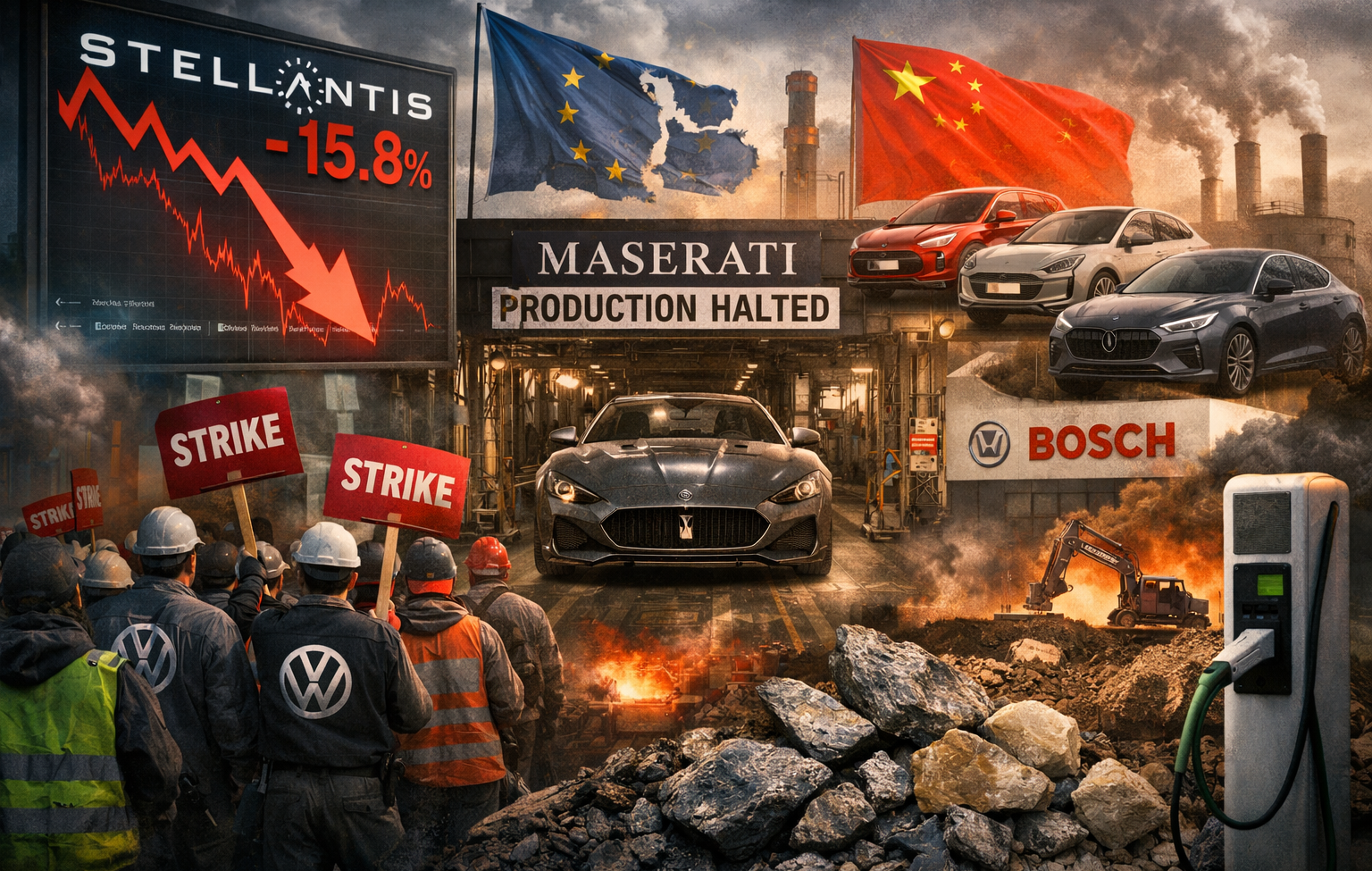
The European automotive industry stands at a crossroads, facing multiple crises that endanger its stability and long-term viability. One of the biggest players in the industry, Stellantis, has seen its stock plummet in the most recent months. This decline reflects investor unease following the abrupt resignation of CEO Carlos Tavares, whose leadership was pivotal in navigating regulatory uncertainties and shifting the company’s focus to affordable electric vehicles. Tavares has been constantly criticizing the slow pace of the European Union’s Euro 7 emissions standards. His reason: regulatory ambiguity slows down innovation, giving faster competitors, especially those from China, a great advantage.
Another major European company, Volkswagen, is also facing similarly difficult challenges.Labor strikes in Germany and Italy have paralyzed production at major facilities, with workers demanding higher wages as inflation rises.These strikes add to Volkswagen’s troubles, as the company struggles with falling profits(a 48% drop in net income this year) and the challenges of shifting to electric vehicle production. Once one of the greatest companies in Europe, and a symbol of German engineering excellence, Volkswagen could now be forced to downsize its production by a great deal just to stay afloat.
Meanwhile, Bosch, the world’s largest automotive supplier, finds itself under immense strain due to the industry’s pivot toward electrification. Once a leader in making internal combustion engine parts, Bosch now has to completely rethink its business to stay relevant in the electric vehicle market, investing heavily in new expertise and production systems, a shift that will likely lead to significant job cuts. These challenges highlight the broader struggles of Europe’s automotive supply chain, which must change its approach to car manufacturing fast, or risk obsolescence.
Luxury carmakers aren’t immune to these challenges either, with even iconic names like Maserati feeling the impact. The brand is grappling with high production costs and an outdated lineup, while its shift to hybrid and electric models has stumbled. This leaves the brand exposed in a market increasingly dominated by innovative, affordable EVs. If these struggles continue, Maserati could lose its status as a symbol of Italian excellence.
Adding another layer to the crisis is the European Union’s ambitious Green Deal, aimed at achieving climate neutrality by 2050. The plan puts the automotive industry at the forefront of the shift toward a sustainable economy. But as debates over the Green Deal intensify, concerns about the affordability and accessibility of electric vehicles are growing. Recent studies show that many Europeans simply cannot afford EVs, threatening adoption rates and deepening economic gaps between member states. On top of that, uneven charging infrastructure presents a major challenge for both policymakers and manufacturers.
Meanwhile, Chinese carmakers are charging ahead, reshaping the global automotive industry. Brands like BYD and NIO have gained significant market share by producing high-quality, affordable EVs, backed by strong government support and integrated supply chains. Their success highlights the competitive gap facing European manufacturers and underscores the urgent need for strategic changes. With the ability to meet global demand more efficiently, Chinese brands are threatening to overtake traditional European names in multiple international markets.
China benefits from the rise of electric vehicles because it controls many of the key resources needed for batteries internally and is developing a market largely untapped by European carmakers. This gives the government a strategic advantage in shaping the global EV market while supporting domestic industries. At the same time, China relies heavily on imported oil from Russia, the Middle East, Africa, and Latin America, making energy security a top priority. Investing in EVs helps reduce dependence on foreign oil and positions China as a leader in clean transport. Combined, these factors give the country both economic and geopolitical leverage in the automotive sector.
In addition to these concerns, despite electric vehicles being widely promoted as a cleaner alternative to traditional cars electric, they present several environmental and geopolitical challenges:
While EVs reduce tailpipe emissions, their overall environmental impact depends significantly on the source of electricity used for charging, often generated from fossil fuels.
Furthermore, the production of EV batteries involves the extraction of minerals such as lithium, cobalt, and nickel. These mining operations can lead to environmental degradation, including habitat destruction and water pollution .
Moreover, most of these critical minerals come from outside Europe: lithium is mainly sourced from Australia, Chile, Argentina, and China; cobalt from the Democratic Republic of Congo, Russia, Australia, and Canada; and nickel from the Philippines, Russia, Canada, and Australia. This reliance raises questions about Europe’s energetic independence, especially in light of the Russia-Ukraine war, ongoing tensions involving China and the Democratic Republic of Congo, and concerns over the sustainability and security of the supply chain of electric vehicles.
Besides, greener cars can be achieved not only through electric vehicles but also by improving engines and developing cleaner fuels. Yet, cars are not the largest source of emissions, residential heating contributes far more in Europe (European Environment Agency, 2022). What’s more, Europe’s efforts, while important, represent only about 7% of global emissions, far less than China or the U.S. (World Resources Institute, 2019). Holding major emitters accountable and promoting fair, sustainable practices worldwide is crucial for meaningful climate progress.
Europe’s car industry stands at a crossroads. Lawmakers and companies must act fast to tackle today’s challenges, balance the costs and benefits of the EV push, and stay competitive against foreign rivals through constant innovation.
If EVs are strategic for China, granting it dominance over a growing market with domestic resources, Europe faces a different challenge. Joining the EV boom could unlock new markets and showcase technological leadership, yet blindly chasing it risks hollowing out Europe’s automotive industry, leaving citizens vulnerable to economic strains and geopolitical tensions. The question remains: should Europe ride the wave or reinvent innovation on its own terms?
Cars still drive millions of jobs and are a major part of Europe’s economy. How leaders respond now will shape the industry for the decades to come.